Showing posts with label found. Show all posts

Sunday, October 16, 2011

The Little Leaf That Did

I was idling down the street, not paying much attention to my surroundings, probably staring at the ground and preoccupied with thoughts that allowed my body to run on autopilot. Without thinking—or at least without thinking about what I was doing—I reached up and pulled a leaf from a branch. Then I stopped walking, realizing what I had done, a tinge of shame curling itself around my face.


A lesson learned

It’s not that I’m a tree hugging don’t-hurt-the-plants proselytizing extremist, but I try to do my best to respect all forms of life. (No offense to self-proclaimed tree huggers.) Pulling the leaf off the tree was uncalled for; childish, even. 

So there I was, standing near the big black spinning cube at Astor Place, staring at this little leaf in my hand, bewildered. What bothered me most of all was my mindless nonchalance, how I acted without a hitch, only afterwards realizing what I’d done. Without my mind to keep it in check, my body had done something I wasn't proud of. That bothered me.

I rubbed the leaf’s glossy finish under my thumb. Instead of letting it fall to the ground I decided to hold onto it until I learned something. And so I continued on my way to dinner with a couple of close friends, still holding the leaf under my thumb. As I went, I thought about design in relation to the leaf.

Beauty came to mind. I began to question: is the leaf even beautiful? is it the best that it can be? Evolution tells us its form is fully derived from its function, to feed the tree. Is that it, then?—beauty derives from a utilitarian perspective? In this case, perhaps, but there are a zillion things that are beautiful and have no inherent use. Or is beauty a use unto itself? It could be that beauty—visual attractiveness—is far more vital to human existence than we give credit. If anything, it would seem to be a tool to soothe the mind.

You can imagine the look on my face, with all these questions popping into my head, when I showed up at the cafe. I had a lot of thoughts and not nearly enough time to explore them. So, still, I held on to the leaf.

When the waitress came over to take our orders she eyed the leaf and reached for it. She must've thought it came from outside by accident. I quickly said, "No! That's a special leaf!" (I wasn't expecting her to go for it, those were the first words that came to mind.) She bounced back, incredulous, probably asking herself what the hell was wrong with me and wishing she had another table instead.

I explained how I ended up with the leaf. I told her I had to learn something from it. She was more interested than I expected, a little amused. My two friends and I started discussing what had just happend, how the waitress probably thought I was crazy. Then another waitress came over and reached for the leaf. Again, I said, "No! It's okay!" She must've heard about it, because she wasn't nearly as startled; she even looked across the restaurant and said something like, "You were right!" to our waitress.

They both came over and the five of us started discussing why the leaf was important. After they left, my friend Adam, on a whim, summed up the lesson I was looking for by saying, "It's amazing that treating something mundane as a precious item has such a huge effect on people."

Whoah.

Saturday, March 26, 2011

Time Warner Cable's Hypno-logo

Three plump men are sitting at the far end of an unnecessarily long boardroom table. A lone figure sits across from them, unapologetically sporting an unbuttoned collar and no tie. The men squint across the ruby surface waiting for the lone figure to begin. He has three packets in front of him, each containing a different logo concept for their company, Time Warner Cable. The man is Steff Geissbuhler, the designer responsible for the NBC peacock logo. 

Steff hands the first packet to a fourth man, an up-and-coming Plumpy whose presence is charged with one task: acting as messenger between the two sides of the table. In his eyes, the first logo concept is the winner; it's elegant, sharp, clever, and perfect for the target audience. 

The distant men barely look at it.

"Too difficult to understand," one Plumpy says. 

"I agree," says another. 

The third nods. "We don't want to confuse anyone."

Steff clicks his pen and sits up straight. His pushes his glasses to the bridge of his nose, even though they're already up as high as they go. Seth hands Plumpy Jr. another packet. The second logo isn't brilliant, but it's solid. He toned down the cleverness, approached the problem literally. 

The three men look glance at the packet. "Too obvious."

"It almost seems childish."

"I could come up with this."

Steff presses his feet into the floor. His face flushes slightly, he can feel himself getting warm. He becomes aware of his breathing. 

He passes along the third logo, already knowing they won't like it. It's impossible, because the idea behind the logo is borderline 1984 Big Brother material. He had trouble coming up with a solid design after the first two, so he went and made a logo that he though represented the reality of the situation: a hypnotizing spiral emanating from the center of an eye. Television is hypnotic garbage, and Time Warner Cable are counter trash-men, delivering the garbage instead of picking it up.

The tree men stare at the logo for a long time. They whisper back and forth. Finally, one speaks.

"Brilliant."


Okay, this probably isn't how it went down, but I'd like to think that Seth isn't responsible for the overtly obnoxious logo above. I admit—I know not all business men are plump, nor are all designers comrades in the fight for humane design. Still, it's hard for me to accept being associated with the kind of insensitive thinker that would come up with a logo like this.

Harsh, you say? Perhaps. But let's think about it. Let's try to step outside the realm of the familiar and objectively look at it. The logo is comprised of two elements. 1) An eye, and 2) a spiral, which is a commonly used symbol for hypnosis. (Don't take my word for it, just google image search "hypnotic" or "hypnosis.")

Now try disassociating "Time Warner Cable" with the logo; let it sit in front of your eyes independently of any linguistic label. With these two elements, the eye and spiral, the logo seems to represent some kind of evil mind-controlling empire hell bent on hypnotizing the masses. And, well, it pretty much is. Yet no one cares.

Monday, February 28, 2011

Insta(picto)gram

Verizon finally got the iPhone and so did I. Before recently I didn't have a big desire to buy it, but then I heard about Instagram. Basically, it's the Facebook of (amateur) photography. Sort of.

You take pictures, run them through one of several color filters, and upload it to your tumblr-like profile. That's it. Sounds simple (of course the best things always seem to be), but it allows for a lot of freedom. See, while you're having at it, so are the people you follow, and everyone's work appears in the real-time feed, just like on Facebook and Twitter. Some people take pictures of their cats, some of their meals, and so on. Everyone interprets the freedom in their own way.

*Intermission* This is beginning to sound like an advertisement. So enough of that. *End of Intermission*

For me, I like taking pictures of everyday things (including a bunch of light fixtures). There isn't much meaning behind my photos beyond the upfront beauty of the world. Yeah, that sounds sappy and cliche, but it's true. When I'm doing graphic design I try to put meaning behind my work, so that if you sit and spend time looking, you might find something beneath the surface. My photo approach is the opposite.

Discussing this with my friend, it seems that a lot of photography is also based around high concept thinking. I won't go into it too much, but I find it interesting that I try to design one way and shoot the opposite. When I'm taking a pic I look at the environment as if I were going to draw it: what looks interesting? are there any exciting colors? odd shapes? beautiful contrasts? etc. I think I judge the photo possibilities on how much find I'd have drawing instead.

At first I was questioning every photo I took, trying to figure out how it would be interpreted by others (a problem I encounter in design as well), and rejecting many. Now I do my best to answer one question and judge the photo based on that: Do I like it?

Yes? Save.—No? Delete.


Sunday, November 7, 2010

Batman: 'Nuff Said


(above not made by me)


Here's my procrastination:


Wednesday, October 6, 2010

Man at the Corner: And His Determination

I was standing on my bed this morning, I forget why, and happened to look out the window. Down on the corner (I'm on the 5th floor) was one of those guys who tries to hand paraphernalia to passersby. The man looked tired.

He was holding a stack of postcards and wearing a sign around his neck. It hung at his stomach, neon text stickers unevenly placed and flashing the latest deal. When there wasn't anyone around he tucked his arms in and shifted his weight from foot to foot, like a penguin waddling in place, biding time, being patient.

For ten minutes, I watched him. The man kept trying and trying and trying to pass out cards. Most people didn't acknowledge his existence, very few looked at him, less said, "No thanks." In ten minutes he only gave away two. Part of the reason I ended up watching him for so long is I was waiting for another person to take a card.

In a way, I felt like I was down there with him. Each rejection upset me (probably more than it did him) and I couldn't look away until we gave just one more out. That sounded cliche and sappy, but I really felt for the guy.

There are a lot of large and important battles that people go through. Fighting cancer comes to mind (a battle my mother lost), physical disabilities such as palsy, and a million other daily struggles. There are also battles of determination and stamina, like the one the guy on the corner faces every day.

I can't imagine standing there for eight hours, thousands of people passing by and still all alone, yet he's down there, straight-faced, handing out cards. Does it sound easy? It may, but I doubt it is. He isn't out there because he loves to do it, he's working for calories and dryness - food and shelter.

Will he ever do something else? Does he want to? Am I being elitist because I can't imagine myself doing this job every day? I don't know. But when I see things like this I'm damn sure appreciative of the amenities and opportunities I have.

Next time you pass someone handing out brochures, take one. I will.

Friday, September 17, 2010

Zen: "Legacy of Letters"

What is Zen? I think we all have a good feeling for what it means, but when I was asked last night to define it I lost my tongue. After a slice of pondering I finally said something akin to, "It's like being at complete peace. Being entirely present and connected to the moment, to the world around you."

Then I went home and Googled it. (Of course.) Wikipedia says, "Zen emphasizes experiential prajñā in the attainment of enlightenment. As such, it de-emphasizes theoretical knowledge in favor of direct realization through meditation and dharma practice." So that helps. Sort of.

After some more ponder-ponder, I began to realize how indefinable the concept of Zen is. Like Love, it's a state of mind, body, and soul that has to be felt to be understood. We can't explain to someone what Love is if they've never felt it. In the same way, we can't really convey what Zen is to those that haven't experienced it.

The good thing is, most of us have felt it. If you've ever been "in the Zone" then you've been in a Zen-like state. Those are the moments in which Time is no longer; where the world is completely and utterly fluid with the self.

I think that every artist, in their own way, strives for a state of Zen in which the process of creation passes through from spirit to action without being tainted by consciousness. In other words, we just let it out, as if we are a witness to what we are doing.

This morning I came across a video of a man practicing the art of calligraphy. You can tell he's in the Zone when he makes perfect line after perfect line.


That is Zen.

Monday, July 19, 2010

A Strange Wave: My Reaction

A lot can be said in a simple gesture.

Yesterday I was in my building elevator with another person. He was on the phone when I walked in - I think he was talking Korean or Chinese - and it cut out as we headed down. He cursed the phone under his breath and held it up, looking for reception to no avail. I must have been staring, because he turned to me as if I'd said something. So I did.

"Technology, eh?" I huffed (not the deepest comment). Then it was his turn to stare - he looked at me as if I were speaking another language, and that's when I realized I was. I smiled at him and he smiled back. Then the elevator door opened and I was already thinking about where I was heading, our meeting destined to be forgotten, until he caught up and stood in my path.


"Excuse me," he said in semi-broken English. He introduced himself and asked me if I knew of any places to eat around our building. Turns out he just moved in and was starving and completely alone. I started to tell him about the local eateries I fancy but his expression said he was having a hard time following.

"Come with me," I said, and led him outside. We walked a couple of blocks and I pointed out some places, told him what kind of food they had, and how much a good meal was. In between stops he told me that he was a fine artist looking to do computer art and animation. It was difficult to communicate, but we both spoke slowly and managed well enough. After our mini tour we said our goodbyes.

This is where it gets good. When we waved goodbye I did the common American wave in which the elbow is generally near the hip, hand is held up about shoulder height, and the hand moves from side to side once, like a sort of lazy salute. My new friend waved me away completely different. His elbow was head height and his arm arched over his head. He didn't just swipe his hand once like I did, either, but instead waved back and forth like a young wife bidding her sailor husband adieu. I couldn't help but draw a huge smile. His wave seemed so innocent and honest compared to the usual American fare.


The typical American wave, aka the lazy salute.


The one-eyed rabbit exampling the stranger's wave.


As so much was expressed in such a simple gesture, the same can be applied to design. It only takes a slightly adjusted nuance here and there to radically change the mood of a piece of work. All it took was a little raising of the hand by about ten inches and the gesture transcended apathetic detachment to wholehearted sincerity.

Being aware of what we're doing is power unto itself. It's one thing for us to randomly fiddle with colors, type, or layout and get something great, but another thing entirely if the choices we make are intentional and the final product a beautiful blossoming flower of conscious decisions.

So, to the unknowing fellow in the elevator: thank you for reminding me.

Friday, May 7, 2010

Catch & Release: Abandoned Art

Eight months ago I moved to New York City, and during my time here I've grown to appreciate a lot of things I didn't expect. One aspect in particular is the city's absolute non-cleanliness.

People often describe NYC as very dirty, but to me it's simply lived in and experienced. Think of the crease lines in an elderly person's face - they represent the time they've witnessed and the wisdom they've cultivated. Like those lines, New York City has marks of age, experience, and wisdom in its own way. The uncleanliness is part and parcel in expressing character and personality.

I love that the desk I'm sitting at as I type this has been used before, complete with paint stains, doodles, carvings, and dents covering every visible surface. I love that the rug leading to the elevator is worn at the center from all the feet that have gone to and fro. Scratches oscillate around the orange call button from all the nails that begged to be satisfied by a glowing arrow and a "ding" sound. Everything screams of human contact. And I haven't even left the building yet.

Imperfections like these give the city a very home-like atmosphere for me. Just like myself (and all of us), the city is imperfect, and there's something very powerful about that simple association. I feel like I can relate to the people who occupy the same space, like we're all part of a team that communicates through our surroundings as opposed through direct interaction.

A couple of years ago I took a trip to Chicago to meet up with a close friend. During my visit she took me to the heart of the city and the waterfront. While the sights were absolutely beautiful I felt a growing uneasiness as I the trip went on. I couldn't put my finger on it while I was there, but when I got home and was asked how I liked the city I could only say, "Very clean." And that's when I realized that it's cleanliness was the quality that was so unsettling to me. There were so many people packed into the city, yet there seemed to be few traces of life beyond actual people.

Recently we were assigned to place art in the public eye in any way we like. This was an opportunity for me to contribute to the character of New York City. I toyed with an idea that required a small team of eager artists, but since I couldn't gather the masses during finals I decided to simplify it. I took four abandoned paintings from the studio, packed them up in my backpack, threw my camera around my neck, and looked for a public place to present them. The video below shows my short journey.

Sunday, March 21, 2010

I Met the Walrus: An Animated Interview

I came across a phenomenal animation/interview on YouTube. The caption reads:
In 1969, a 14-year-old Beatle fanatic named Jerry Levitan snuck into John Lennon's hotel room in Toronto and convinced him to do an interview. 38 years later, Levitan, director Josh Raskin and illustrators James Braithwaite and Alex Kurina have collaborated to create an animated short film using the original interview recording as the soundtrack. A spellbinding vessel for Lennon's boundless wit and timeless message, I Met the Walrus was nominated for the 2008 Academy Award for Animated Short and won the 2009 Emmy for 'New Approaches' (making it the first film to win an Emmy on behalf of the internet).

Sunday, March 14, 2010

Running from Camera: Simple and Beautiful

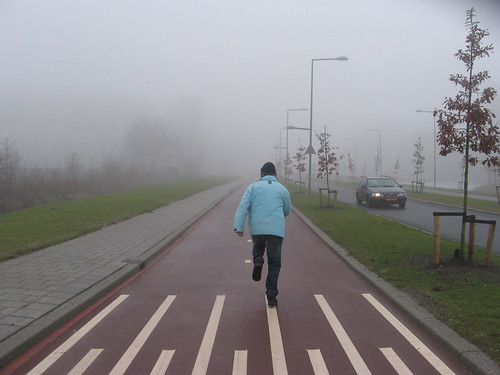
I came across a blog so awesome I have to share it. It's called Running from Camera and, as the author puts it, "The rules are simple: I put the self-timer on 2 seconds, push the button and try to get as far from the camera as I can."

As of today the author/artist has 108 shots. Below are some of my favorites.


107. Zuiderparkweg, Rotterdam